


News & Insights
Stay Informed. Stay Connected.
How cellulose ethers affect water retention in tile adhesives
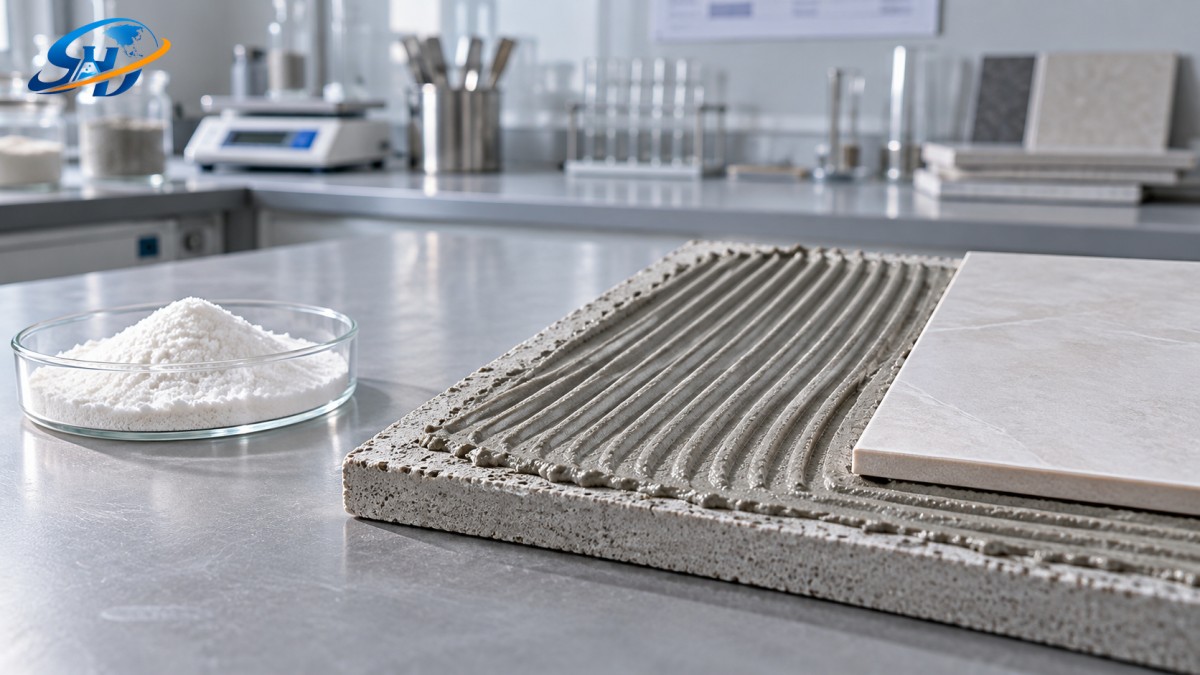
Cellulose ethers improve water retention in cement-based tile adhesives by slowing water loss from the fresh mortar, particularly into absorbent substrates. This helps preserve the moisture needed for cement hydration and gives installers more time to place tiles while the adhesive can still wet their backs. The benefit depends on the complete formulation and application conditions: a higher-viscosity grade does not automatically deliver better water retention or longer usable open time.
For technical evaluation, the useful question is whether a cellulose ether retains sufficient water at the intended mixing ratio while maintaining tile wetting, workability, slip resistance, and bond development. A formulation can retain water well in a laboratory test yet develop a surface skin too quickly during installation.
How cellulose ethers influence water movement
When properly dissolved in the mixing water, cellulose ethers such as hydroxypropyl methylcellulose (HPMC) and hydroxyethyl methylcellulose (HEMC) increase the viscosity of the aqueous phase and influence the mortar’s resistance to water movement. These effects reduce the rate at which an absorbent substrate draws water out of the adhesive. Their performance depends on polymer chemistry, concentration, dissolution, and interactions with the other mortar ingredients.
This matters because a thin adhesive bed has limited water available. Rapid suction can leave parts of the mortar short of moisture before adequate hydration and bond development occur. Exposed adhesive ridges also lose moisture to the air, especially under warm, dry, or windy conditions. Cellulose ethers help manage that loss, but they cannot prevent drying indefinitely.
Water retention and open time therefore need separate evaluation. Water retention describes how well the mortar resists losing water under defined conditions. Open time concerns the interval after spreading during which tiles can be installed and still achieve the required adhesion. Moisture remaining inside the mortar does not guarantee that its exposed surface will still transfer effectively to the tile.
Why viscosity alone is a weak selection criterion
A viscosity value describes a cellulose ether solution under specified measurement conditions. Comparing values is meaningful only when concentration, temperature, and test method are comparable. Even then, solution viscosity cannot fully predict behavior in a cementitious mixture containing mineral particles, dissolved salts, and other additives.
Grades with similar nominal viscosity can differ in substitution chemistry, dissolution behavior, and modification package. These differences can affect water retention, consistency development, air entrainment, and setting behavior. Particle size and surface treatment can also influence how quickly the polymer becomes effective during mixing and maturation.
Increasing dosage may improve retention when the original level is insufficient. Beyond a useful range, the additional benefit can diminish while changes in consistency, air content, or setting become more significant. Excessive resistance to flow can make spreading harder and reduce ridge collapse under tile placement pressure. A stable ridge is useful for slip resistance, but it must still deform enough to provide adequate contact.
Comparisons also become misleading when operators add extra water simply to make a thicker formulation feel workable. The resulting differences in adhesion and drying then reflect both the cellulose ether and the changed water content.
Evaluate the grade in the conditions that drive water loss
The same cellulose ether can perform differently as cement characteristics, fine-particle content, aggregate grading, or other additives change. Substrate suction and application thickness further affect how quickly the adhesive loses moisture. Grade screening should therefore use the intended base formulation, followed by conditions representative of the planned application.
A practical comparison should address four points:
- Control preparation. Keep raw materials, mixing sequence, maturation time, and test timing consistent. Start at a fixed water addition to isolate grade effects, then assess any water adjustment needed to reach the intended application consistency.
- Measure retention reproducibly. Use a defined procedure and record the suction medium, contact time, temperature, and calculation method. Results from different procedures may not be directly comparable.
- Check exposed-bed performance. Evaluate tile transfer and adhesion after defined placement delays, including relevant drying conditions. Surface appearance or a finger-touch check alone cannot establish acceptable open time.
- Track competing properties. Assess spreading, ridge collapse, slip, fresh-mortar density or air content, setting behavior, and adhesion under the conditioning relevant to the product specification.
Where a tile adhesive standard applies, distinguish internal water-retention screening from the standardized tests used to support performance claims. A favorable retention result cannot substitute for open-time or adhesion testing.
A useful selection endpoint is the lowest effective dosage that maintains moisture retention and tile wetting across the intended application window while meeting the other performance requirements. If retention improves but delayed-placement adhesion remains poor, investigate surface drying, wetting, contact area, air content, and hydration behavior before increasing the cellulose ether dosage again.
Related Posts
- ▶ How to control heat buildup when diluting sodium hydroxide solutions
- ▶ How cellulose ethers affect water retention in tile adhesives
- ▶ When is anhydrous citric acid preferable for dry powder blends?
- ▶ Is rutile titanium dioxide better than anatase for exterior paint?
- ▶ How to prevent polyacrylamide lumps during solution preparation
- ▶ How to verify the active ingredient content of plant extracts
Send Us A Message