


News & Insights
Stay Informed. Stay Connected.
When is anhydrous citric acid preferable for dry powder blends?
Anhydrous Citric Acid is generally preferable for dry powder blends when the formulation needs minimal water input, a higher acid content per unit mass, or tighter control of moisture-sensitive reactions. It is particularly worth evaluating for effervescent powders and other systems where small amounts of available moisture can affect stability. However, “anhydrous” does not mean moisture-proof, and it does not automatically mean better flow.
For technical evaluators, the useful question is not simply which form contains less water. It is whether the selected grade will maintain the required acidity, blend uniformity, and handling performance throughout processing and storage.
Start with the water budget—and distinguish bound water from available moisture
Citric acid monohydrate contains one molecule of water of crystallization per molecule of citric acid. This represents approximately 8.6% of its theoretical mass. Anhydrous citric acid has no water of crystallization, making it a logical starting point when formulation specifications restrict total water.
That distinction needs careful interpretation. Water bound in a crystal is not equivalent to free surface moisture, and its presence alone does not establish that a blend will be unstable. Conversely, an anhydrous material can acquire moisture during transport, dispensing, or production. Temperature, relative humidity, exposure time, and the other ingredients determine the practical risk.
Prefer the anhydrous form when reducing crystal-bound water is important, but validate moisture availability and stability in the complete formulation. A total-water result alone may not explain how a powder will behave.
Compare acid equivalents before replacing one form with the other
A kilogram-for-kilogram substitution changes the amount of citric acid delivered. On a theoretical pure-material basis, the molecular weights are approximately 192.12 g/mol for anhydrous citric acid and 210.14 g/mol for the monohydrate.
These figures are conversion factors, not finished-product specifications. Correct dosing for actual assay and confirm whether the supplier reports assay on an as-is, dry, or anhydrous basis. In an effervescent blend, also recalculate the acid–bicarbonate balance rather than carrying over the original ingredient weights. The substitution can alter gas yield per dose, residual acidity, and finished-product performance.
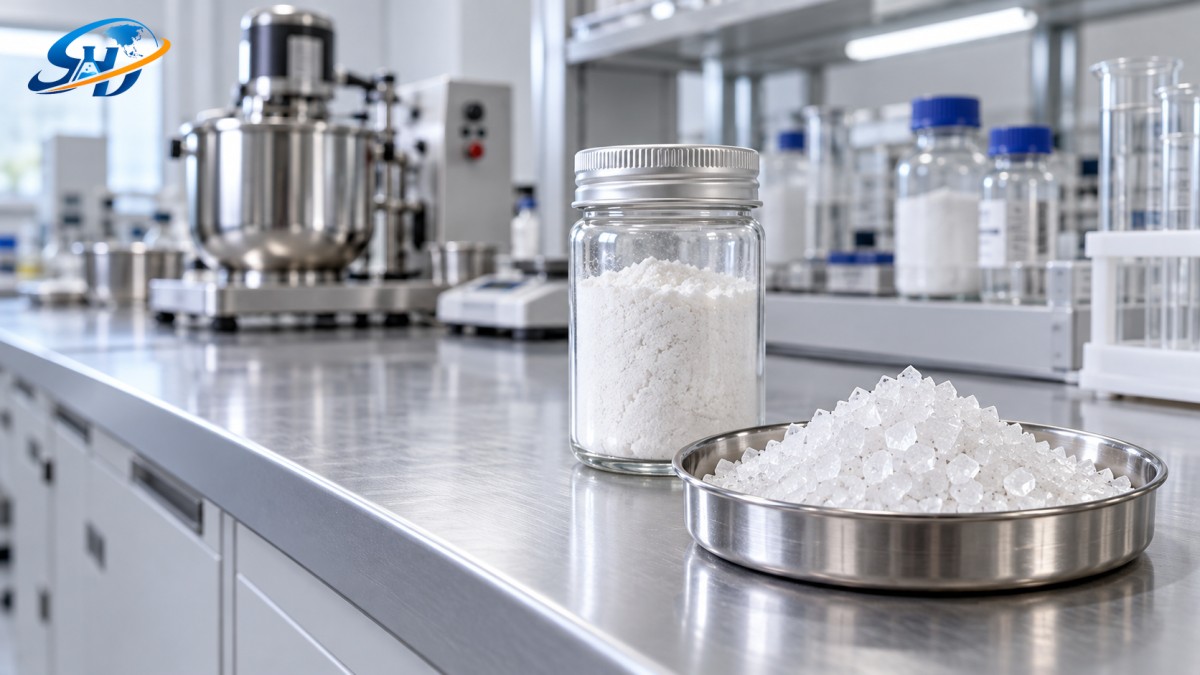
Where anhydrous Citric Acid earns its place
Moisture-sensitive and effervescent blends
In powders containing bicarbonates or carbonates, available moisture can initiate premature reaction, causing caking, gas loss, or changes in performance. Selecting anhydrous citric acid removes crystal-bound water from the acid ingredient, but it addresses only one part of the problem. Moisture from other raw materials, humid air, or inadequate packaging may still dominate stability.
The strongest justification is a formulation trial showing that the anhydrous grade improves storage performance under realistic conditions—not simply a lower water value on its certificate of analysis.
Concentrated formulations or restricted dose sizes
Where sachet weight, tablet size, or total powder loading is constrained, the anhydrous form delivers more acid per unit mass. That can provide formulation flexibility, provided the revised proportions still meet bulk density, blending, and dissolution requirements.
Processes with temperature exposure
If drying, warm mixing, or other thermal steps could change the hydrate state, evaluate those conditions explicitly. Dehydration or moisture redistribution can affect physical behavior. Anhydrous material may simplify the water balance, but it does not eliminate the need to assess thermal stability and compatibility with neighboring ingredients.
Do not let crystal form hide a particle-size problem
A chemically suitable acid can still segregate in the blender or bridge during discharge. Particle-size distribution, fines content, crystal shape, and bulk density all influence handling. A fine anhydrous grade may perform worse than a suitably sized monohydrate grade if it increases dust, cohesion, or segregation.
Ask suppliers for specifications that match the application: particle-size limits, moisture limits and test methods, assay basis, bulk-density information, and packaging details. For regulated applications, confirm the appropriate grade and applicable compendial or regulatory requirements. Product names alone are not a sufficient purchasing specification.
Make the decision with a side-by-side qualification
A practical comparison should use acid-equivalent formulations and representative production conditions. Focus on the outcomes that could prevent release or shorten shelf life:
- During blending: assess uniformity, segregation, dust generation, flow, and discharge behavior.
- During exposure: examine moisture pickup and caking under expected plant humidity and handling times.
- In the final package: track moisture, appearance, acidity, dissolution, and application-specific performance over storage.
- For effervescent systems: include evidence of premature reaction and retained effervescence.
Choose anhydrous citric acid when its lower water contribution or higher acid loading produces a measurable formulation advantage. If monohydrate already meets stability and processing requirements, changing forms may add qualification work without improving the blend. The right selection is the grade whose chemistry, particle characteristics, and packaging remain reliable together—not the one with the more reassuring name.
Related Posts
- ▶ How to control heat buildup when diluting sodium hydroxide solutions
- ▶ How cellulose ethers affect water retention in tile adhesives
- ▶ When is anhydrous citric acid preferable for dry powder blends?
- ▶ Is rutile titanium dioxide better than anatase for exterior paint?
- ▶ How to prevent polyacrylamide lumps during solution preparation
- ▶ How to verify the active ingredient content of plant extracts
Send Us A Message