


News & Insights
Stay Informed. Stay Connected.
How to verify the active ingredient content of plant extracts
To verify the active ingredient content of plant extracts, test a representative batch sample using a method that measures the declared compounds and reports results on the same basis as the specification. A supplier’s certificate of analysis (CoA) is useful evidence, but its value depends on the sampling procedure, analytical method, reference standards, and calculation behind the reported result.
A potency figure alone cannot establish whether an extract is suitable for production. The practical question is whether that figure accurately describes the material being purchased and used.
Define exactly what the content claim means
Before ordering tests, establish what the specification measures. A named compound, a group of related compounds, and a broad category such as “total polyphenols” require different analytical approaches. An extract ratio describes the relationship between starting botanical material and extract; it does not establish active ingredient concentration.
Also distinguish an active constituent from an analytical marker. A marker can help assess identity or consistency without being responsible for the extract’s intended activity. Measuring one marker does not automatically verify every relevant constituent.
The specification should identify:
- The botanical species, plant part, and extract form.
- The compound or defined group of compounds being measured.
- The acceptance limit or range and reporting units.
- Whether content is reported as received, on a dry basis, or on another defined basis.
- The analytical method and any carriers or other added ingredients.
These details prevent a common purchasing problem: comparing two apparently similar potency claims that measure different things.
Make the sample represent the batch
Even a well-performing instrument cannot correct an unrepresentative sample. Powder blends can segregate, while liquid extracts may settle or separate. Sampling should follow a documented plan that accounts for batch size, container distribution, physical form, and expected variability.
Collect portions from appropriate locations or containers using suitable equipment. A composite sample can estimate average content, but it may conceal differences between containers. Where uniformity matters, keep individual samples for separate testing.
Protect samples against moisture, light, heat, or oxygen where the target compounds are sensitive. Record the batch identity, sampling locations, storage conditions, and sampling date. Keep a retained sample so that unexpected results can be investigated against the same material.
Choose a method that distinguishes the target compounds
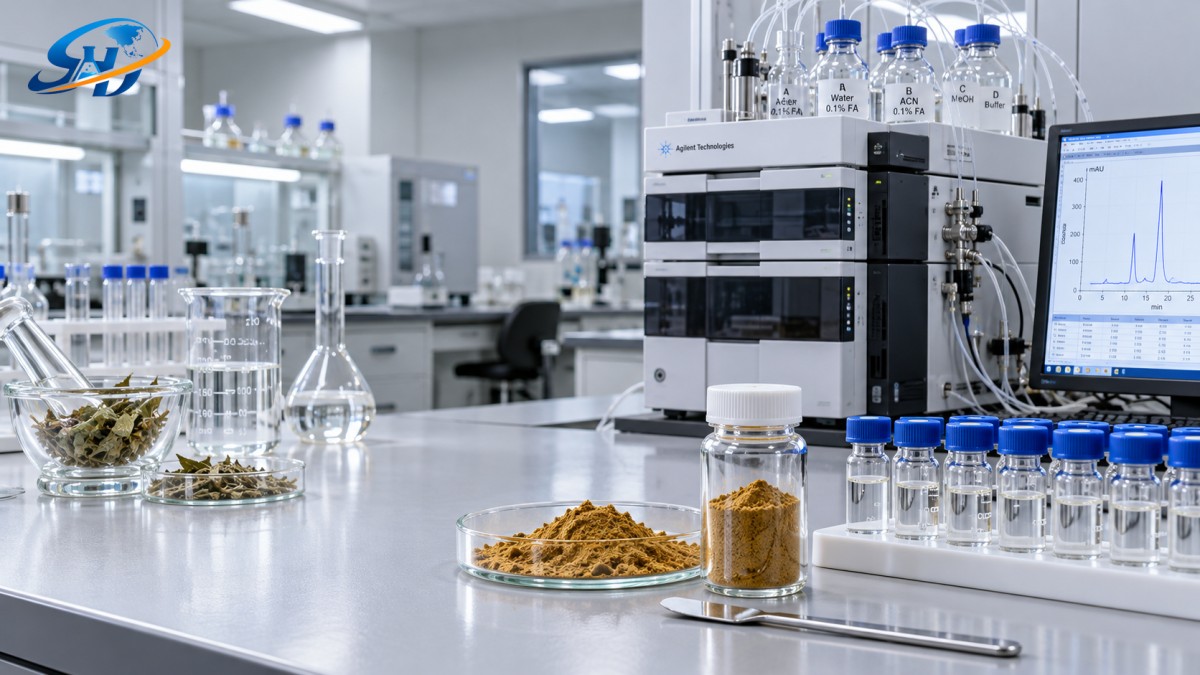
High-performance liquid chromatography (HPLC) is often suitable for nonvolatile constituents because it separates compounds before measurement. However, an HPLC result is only meaningful when sample preparation, separation, and detection are suitable for the particular extract. A method developed for one botanical matrix may encounter interference in another.
Gas chromatography can suit volatile constituents, such as components of essential oils. Liquid chromatography coupled with mass spectrometry can provide additional selectivity when compounds are difficult to distinguish or occur at low levels, although matrix effects still require evaluation.
UV-visible and colorimetric assays can be useful for defined group measurements or routine screening. Their limitation is specificity: several substances may contribute to the signal. A result expressed as equivalents of a reference compound should not be interpreted as the measured amount of every individual compound in that group.
Chromatographic peak area percentage also should not be treated automatically as mass percentage. Different compounds can produce different detector responses. Quantitative results require appropriate calibration and, where applicable, justified response factors.
Check calibration, extraction recovery, and method performance
Reference standards should have documented identity, assigned purity or content, and suitable storage conditions. Calculations must account for the assigned value. A poorly characterized standard can introduce systematic error even when repeated measurements look consistent.
Sample preparation deserves equal attention. The extraction solvent and procedure must release the target constituents from the material without causing unacceptable degradation. Incomplete extraction can produce a low result; interfering substances can produce an apparently high one.
For batch acceptance, examine evidence that the method performs adequately in the relevant matrix and concentration range:
- Specificity: other constituents do not interfere with the reported measurement.
- Accuracy: recovery studies or suitable reference materials support the result’s closeness to the expected value.
- Precision: repeated sample preparations give sufficiently consistent results.
- Range and calibration: the method supports reliable quantification around the specification limits.
- Robustness and solution stability: reasonable procedural variation and analytical holding time do not undermine results.
Routine analysis should also meet defined system suitability criteria. Repeated injections demonstrate instrument repeatability; they do not establish that sampling and extraction were reliable.
Compare results on the same reporting basis
A dry-basis result excludes the measured moisture contribution, while an as-received result describes the material in its supplied condition. Comparing them directly can create an apparent discrepancy even when both calculations are correct.
Where the specification defines the correction using water content, the relationship is:
Dry-basis content = as-received content ÷ (1 − water mass fraction).
Use the correction defined by the method. Loss on drying may include volatile substances other than water and is not always interchangeable with a water-specific measurement. Carrier content and dilution factors must also be handled consistently.
For a result near an acceptance limit, apply a predefined decision rule that addresses measurement uncertainty where relevant. If independent testing disagrees with the CoA, investigate sampling, reporting basis, standards, extraction, and calculations before deciding the batch disposition. Repeated testing until a passing value appears does not resolve the discrepancy.
Request a batch-specific report identifying the method, units, reporting basis, and any deviations. Identity, contaminants, residual solvents, and microbiological quality require separate controls: an acceptable active ingredient assay answers the potency question, but cannot establish overall material quality.
Related Posts
- ▶ How to control heat buildup when diluting sodium hydroxide solutions
- ▶ How cellulose ethers affect water retention in tile adhesives
- ▶ When is anhydrous citric acid preferable for dry powder blends?
- ▶ Is rutile titanium dioxide better than anatase for exterior paint?
- ▶ How to prevent polyacrylamide lumps during solution preparation
- ▶ How to verify the active ingredient content of plant extracts
Send Us A Message